
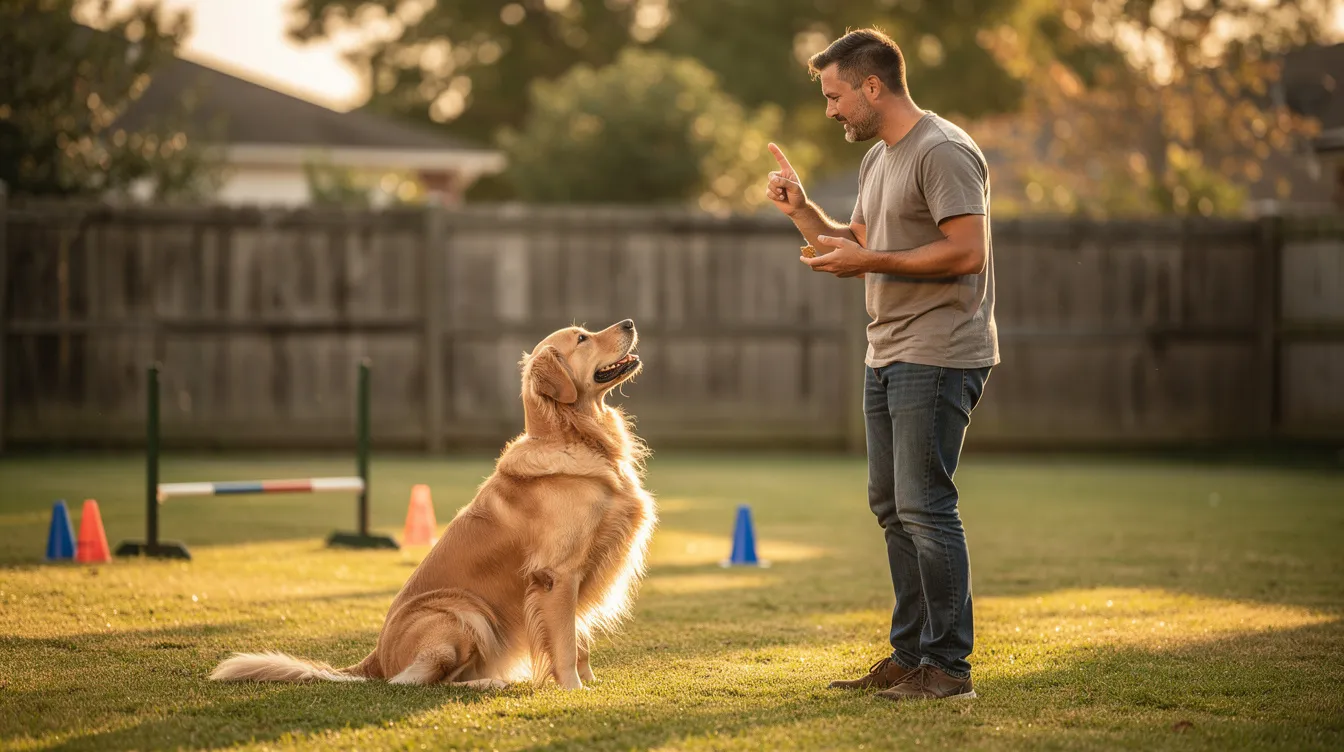
Golden retriever training starts with one fundamental truth: this breed wants to work with you, not against you. Golden Retrievers are ranked among the top five most intelligent breeds, and their eagerness to please their owners makes them exceptionally responsive to structured training. Whether you’re raising a golden retriever puppy or working with an adult dog, the methods that produce lasting results follow a clear, repeatable pattern.
This guide covers everything from basic obedience and house training through advanced off-leash recall for golden retrievers of all ages. It’s written for golden retriever owners who want reliable, structured training methods – not vague advice – to build better behavior and a stronger bond with their dog. If you’re dealing with jumping, pulling, mouthiness, or selective listening, you’ll find specific solutions here. If you’re preparing for off-leash freedom, you’ll find the progression that gets you there safely.
The direct answer: Golden retrievers respond best to consistent positive reinforcement combined with clear boundaries. Training should start early, focus on impulse control and basic commands like sit, stay, and come, and progress gradually through increasing levels of distraction. Training sessions should be kept to 5 to 10 minutes several times a day to maintain focus and motivation.
By the end of this guide, you’ll understand how to:
The golden retriever temperament is what makes this breed one of the most popular family dogs in the world – and it’s also what shapes every training decision you’ll make. Understanding how your golden retriever learns, what motivates them, and where they’re likely to struggle is the difference between efficient training and months of frustration.
Golden Retrievers are deeply social and love to greet everyone. Their people-oriented nature means they respond strongly to rewards tied to human interaction: verbal praise, play, attention, and physical affection. This is a breed that’s genuinely food-motivated, but also driven by the desire to engage with their handler. That dual motivation gives you powerful training leverage.
A large-scale behavioral study of approximately 1,343 adult Golden Retrievers using the C-BARQ (Canine Behavioral Assessment and Research Questionnaire) confirmed what experienced trainers already know: this breed scores high on trainability and low on aggression, dog rivalry, and stranger-directed fear. Golden Retrievers need mental stimulation, not just physical exercise. Their high energy level – especially during the puppy and adolescent phases – demands both physical exercise and structured mental challenges. Daily exercise should include mental challenges for Golden Retrievers, such as puzzle toys, trick training, and scent work. A tired golden isn’t just a physically exhausted dog; it’s a mentally satisfied one.
However, not all dogs within the same breed are identical. Genome-wide association studies have identified 12 loci with genome-wide significance tied to behavioral traits like energy level, trainability, and fear responses. The heritability of these traits ranges from about 5% to nearly 70%, meaning genetics and environment both play significant roles. This is why some golden retriever owners find their dog picks up commands in days while others need weeks – and why a one-size-fits-all approach doesn’t work.
Golden Retrievers often exhibit a surprising stubborn streak, particularly when something more interesting competes for their attention. They require 30 to 60 minutes of exercise daily as puppies, and structured training sessions provide essential mental stimulation that physical exercise alone cannot replace. Teaching calmness is important for energetic breeds like Golden Retrievers – it’s a skill that must be actively trained, not passively hoped for.
Training a Golden Retriever means confronting breed-specific behavior patterns that stem directly from their working dog heritage. These dogs were bred to retrieve game, carry things in their mouths, and work alongside hunters in the field. Those instincts don’t disappear in a suburban living room.
The most common challenges many Golden Retriever owners face include:
Golden Retrievers need to learn self-control to manage excitement. Training should focus on behaviors like impulse control and mouthiness before expecting reliable performance on more complex commands. Understanding these breed-driven patterns is what makes the practical training methods in the following sections effective rather than generic.
With a solid understanding of how your golden retriever thinks and what drives their behavior, the next step is building a foundation of reliable commands. Every advanced skill – from off-leash recall to calm behavior when guests arrive – depends on these fundamentals.
Basic obedience commands include sit, stay, come, down, and leave it. For a golden retriever puppy, basic training should begin the day they come home. Training should start early to prevent bad habits in Golden Retrievers – it’s far easier to build correct behavior from scratch than to undo months of rehearsed mistakes.
Positive reinforcement is the most effective training method for this breed. Positive reinforcement builds a strong association that good behavior is rewarded, and it works with the Golden Retriever’s natural desire to please rather than against it. Use a marker – a clicker or a verbal “yes!” – to signal the exact moment your dog performs correctly. This precision sharpens learning speed considerably.
Practical framework for teaching any basic command:
Frequent rewards for good behavior reinforce learning and maintain motivation. Consistency in training cues is crucial for effective dog training – every family member must use the same words, the same hand signals, and the same expectations. Mixed cues from different family members create confusion and slow progress. Most dogs can achieve reliable basic obedience within 4 to 6 months of consistent practice.
Training sessions should focus on impulse control before other commands. A golden retriever that can’t hold a “wait” at a doorway isn’t ready for a reliable recall in an open field. Self-control is essential for Golden Retrievers to ignore distractions, and it must be developed through structured training activities like “wait for food,” “sit to greet,” and “place” commands.
Potty training a golden retriever puppy follows a predictable timeline tied to bladder development. A commonly used guideline: a puppy can hold its bladder approximately one hour per month of age during the day. A three-month-old puppy can manage roughly three hours; a four-month-old, about four. Overnight capacity is slightly better but still limited.
When you crate train your golden retriever, you leverage their instinct to avoid soiling their sleeping area. The crate should be sized so the puppy can stand, turn around, and lie down – but not so large that they can eliminate in one corner and sleep in another. For young puppies, crate time during the day should never exceed their physical capacity to hold it, with a general maximum of four hours for puppies under six months.
Beyond elimination training, crate training serves a deeper purpose: it teaches your golden retriever puppy to settle, self-soothe, and find calm in a den-like space. This directly supports impulse control development and reduces separation-related anxiety. A puppy’s life is full of stimulation, and the crate provides a structured opportunity to decompress.
Key potty training tips:
Leash pulling is one of the top complaints among many owners of golden retrievers, and it’s where many golden retriever owners give up too early. A three-stage approach works well for this breed:
Stage 1 – Leash acceptance (indoors): Let your puppy drag a lightweight leash around the house under supervision. Practice walking a few steps with treats held at your side. No outdoor distractions yet.
Stage 2 – Pressure-pause (low distraction outdoors): When the leash goes tight, stop moving entirely. Wait for your dog to look back at you or create slack. Mark and reward. Resume walking. This stage requires patience – sessions of just 5 to 10 minutes initially work better than long walks where the dog’s attention gets overwhelmed.
Stage 3 – Reward position: Actively reinforce the position you want – your dog walking at your side with a loose leash. Treat frequently at first, then gradually fade.
Most golden retriever owners see substantial improvement within 3 to 6 weeks of consistent work using this structured approach. If regression occurs, drop back one stage. The progression from indoor practice to quiet streets to busy neighborhoods should feel gradual, not rushed.

Once your golden retriever has solid basic commands and can demonstrate impulse control in moderate distractions, you’re ready to build toward more advanced skills. This is where golden retriever training becomes genuinely rewarding – and where many pet owners discover what their dog is truly capable of.
Golden Retrievers can participate in off-leash obedience training, and for many owners, this is the ultimate goal. But off-leash reliability requires a methodical progression – skipping steps leads to dangerous failures and eroded trust.
Owners should expect 6 to 12 months of progressive training for consistent real-world off-leash reliability. Pushing too early risks accidents, trust erosion, and safety problems for your dog and others.
Understanding the trade-offs between training approaches helps you make informed decisions about what’s right for your golden retriever at their current stage.
| Criterion | Positive Reinforcement | Balanced Training | Professional Board & Train |
|---|---|---|---|
| Effectiveness | High for most behaviors | High across all behaviors | Very high for complex issues |
| Time Investment | Moderate to high | Moderate | Low (owner time) |
| Best For | Puppies, basic training, sensitive dogs | Adolescents, ingrained habits, off-leash work | Busy dog owners, severe behavioral issues |
| Risk Level | Very low | Moderate (requires skill) | Low (handled by professionals) |
| Long-Term Results | Excellent with consistency | Excellent with ongoing practice | Excellent with owner follow-through |
Reward-based training is recommended over punishment-based methods by the majority of veterinary behaviorists. For golden retrievers specifically, positive reinforcement harnesses their natural drive to please and maintains trust. Balanced approaches – which may include tools like e-collars under professional guidance – can provide “last mile” improvements for adult dogs with ingrained problems, but e-collar training should only be introduced after solid baseline behaviors are established and ideally under expert supervision.
Agility and scent work are great mental exercises for Goldens that complement obedience training. Cross-training across multiple activities builds a more adaptable, confident dog and provides the mental energy outlet this breed desperately needs.

Even with the best approach, every golden retriever owner will hit roadblocks. The key is recognizing that these challenges are predictable and solvable – not signs that your dog is untrainable.
Golden Retrievers are deeply social and love to greet everyone – which translates to launching themselves at every person who walks through the door. Impulse control can be developed through structured training activities specifically designed for this scenario.
Solution: Teach a rock-solid “sit to greet” protocol. When guests arrive, your dog must sit before receiving any attention. If they break the sit, the person turns away and ignores them. Reward the sit with attention and a calm greeting. Practice with family members dozens of times before testing with visitors. Every person who interacts with your dog must follow the same rules – inconsistency here is the most common reason this fails.
Golden Retriever puppies chew because they’re teething. Adolescents and adults chew because of their retrieve game instincts and, often, insufficient mental stimulation. Puzzle toys can effectively engage a Golden Retriever’s mind and redirect the need to chew toward appropriate outlets.
Solution: Provide a rotating selection of appropriate chew toys – rope toys for playing tug, rubber puzzle toys for independent engagement, and frozen stuffed Kongs for settling practice. Teach “leave it” and “drop it” as core commands rather than chasing your dog around the house. When your dog picks up something inappropriate, offer a trade with a high-value treat rather than grabbing the item, which often triggers a keep-away game. Most dogs will naturally reduce mouthiness as bite inhibition develops through consistent redirection from an early age.
This is perhaps the most frustrating challenge for dog owners. Your golden retriever learns every command perfectly in the kitchen but acts as if they’ve never heard the word “come” at the park. This isn’t bad behavior – it’s a generalization problem.
Solution: Use the distraction ladder approach. Only advance to harder environments when reliability at the current level reaches approximately 90%. If your dog fails more than 1 in 10 repetitions at any level, you’ve moved too fast. Drop back, build more value at the easier level, and try again. Use high-value rewards to motivate dogs in distracting environments – the reward must compete with the distraction. Never call your dog for something aversive (ending play, going home, bath time), or you’ll poison the recall cue and create a dog that actively avoids coming when called.
A guide dog organization tracking Golden Retrievers from 6 to 12 months documented that structured early environmental management, predictable routines, and consistent socialization significantly reduced separation-related problems and non-social fear. This research reinforces that persistence through the difficult adolescent phase – rather than giving up – makes all the difference.
Socialization should occur between 8 and 16 weeks of age. Golden Retriever puppies need socialization during this critical window to develop into confident, well-behaved adults. Gradual exposure to new stimuli helps puppies feel comfortable in their environment, while positive experiences during socialization prevent adult fearfulness.
Solution: Create a structured socialization plan that exposes your puppy to a variety of people, unknown dogs, other animals, surfaces, sounds, and environments. Early socialization teaches Goldens to be calm around new people and reduces the risk of anxiety and reactivity in adulthood. Keep exposures brief, positive, and within your puppy’s comfort level – flooding creates fear, not confidence. Group classes can provide socialization and obedience training opportunities in a controlled setting, and puppy training classes offer structured environments where your golden retriever puppy can learn body language and appropriate interaction with other dogs.
Successful golden retriever training requires understanding their breed traits, applying consistent positive reinforcement, and building skills progressively from simple to complex. Most golden retrievers thrive when training is structured, frequent, and genuinely rewarding – for both the dog and the handler. A well-trained golden retriever isn’t the product of one big effort but of hundreds of short, intentional training sessions integrated into everyday life.
Start here:
For more training tips on related topics, explore advanced obedience progression, therapy dog certification pathways, and specialized behavior modification for reactive or aggressive dogs. Golden Retrievers are among the most versatile breeds – and with the right training foundation, there’s very little they can’t learn.
For Golden Retriever owners seeking expert guidance, professional training services can dramatically accelerate progress – particularly for off-leash reliability, reactivity, and ingrained behavioral patterns. Individual training programs offer personalized attention tailored to your dog’s specific challenges, while group classes provide socialization alongside structured obedience work.
For dog owners with demanding schedules, board-and-train programs offer intensive behavior modification where your dog lives with a professional trainer for two to three weeks. These programs are especially effective for adolescent golden retrievers struggling with impulse control, leash reactivity, or off-leash training foundations.
Golden Retrievers need 30 to 60 minutes of exercise daily, combined with mental stimulation through activities like a retrieve game, scent work, or trick training. How much exercise your individual dog needs depends on age, health, and energy level – but weight management and joint health should always factor into your activity planning, as this breed has relatively slow physical maturation and is prone to joint issues if over-exercised too young.