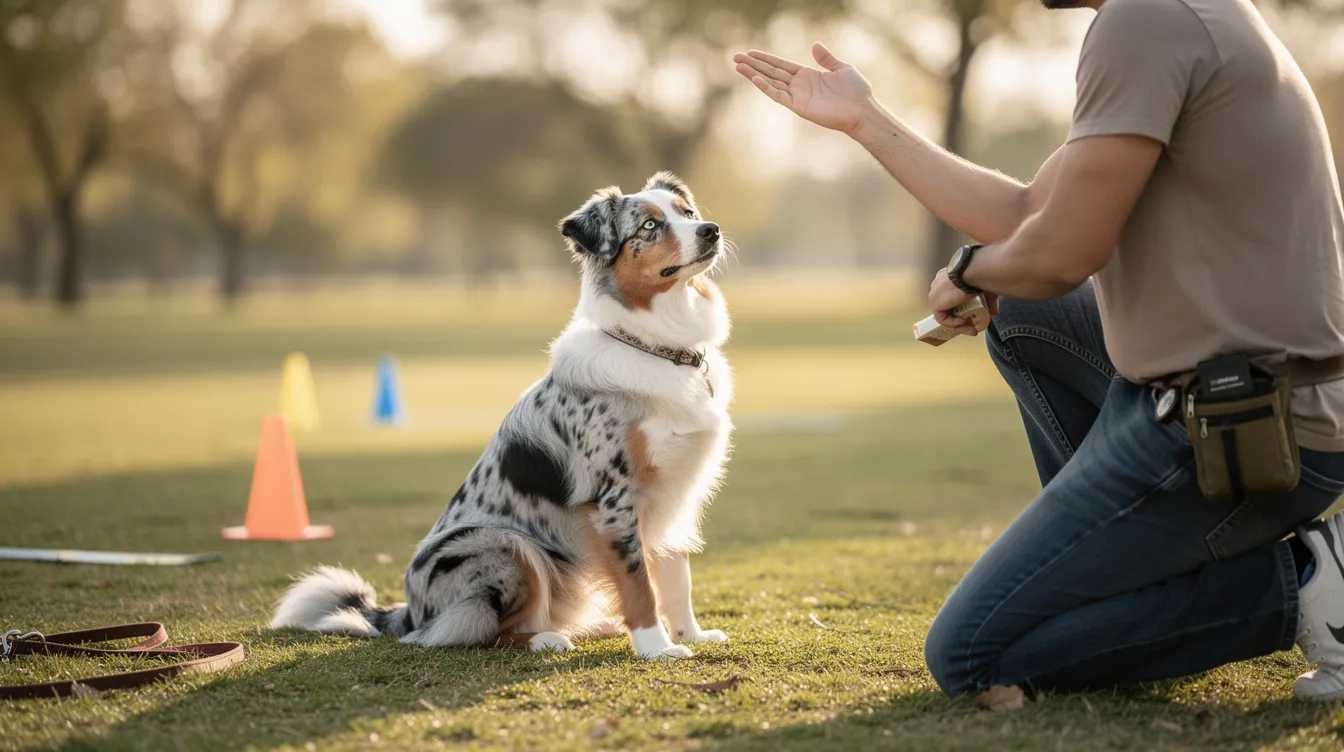
Australian Shepherds are among the smartest, most driven herding breeds in the world-and that combination of intelligence, energy, and instinct means training an Australian Shepherd requires far more structure and consistency than most breeds demand. Without a clear plan, even the cutest Aussie puppy can quickly become a frustrated, destructive adult dog that herds your kids, ignores your commands, and runs your household on its own devices.
This guide covers everything from foundational obedience through advanced off-leash training, targeting Australian Shepherd owners in Northern Virginia and beyond who want reliable, high-level control over their dog in real-world environments. Whether you’re raising an Aussie puppy or working with an adolescent that’s developed selective hearing, you’ll find actionable techniques here. What falls outside the scope: breed-specific health protocols and competitive herding trial preparation.
The short answer: Australian Shepherds are best trained using a combination of positive reinforcement, structured consistency, clear boundaries, and advanced techniques like e-collar training for off-leash reliability. This breed needs a handler who provides both mental engagement and calm leadership-not just treats and repetition.
By the end of this guide, you’ll know how to:
The Australian Shepherd is a working dog bred for decision-making, problem-solving, and sustained physical exercise across demanding terrain. Understanding these breed-specific traits is the first step toward effective Australian Shepherd training-because what works for a Labrador or a Goldendoodle often falls short with this breed.
Aussies are highly intelligent and can learn complex tasks quickly, but that intelligence cuts both ways. They’re known for exploiting loopholes in training: performing just well enough to earn a reward, then testing whether the rules still apply five minutes later. Traditional treat-based dog training can hit a ceiling with this breed because many Aussies will disengage from repetitive exercises, especially when the food reward competes with an interesting smell, a squirrel, or other animals in the environment.
Research comparing training methods confirms that reward-based training yields strong results in terms of recall, response latency, and first-command compliance-but with Australian Shepherds, the reward structure must be varied, the sessions must be brief, and the handler must maintain consistent expectations. A 15-minute training session can tire an Australian Shepherd more than an hour of running, because mental exercises tire Australian Shepherds more than physical exercise alone.
Australian Shepherds occupy a unique position among herding breeds. Unlike a Border Collie, which tends toward silent gathering behavior, or a Heeler, which relies on vocal pressure, Aussies use a blend of body language, eye contact, and occasional nipping or barking to control movement. This working heritage means they’re constantly reading your energy, posture, and tone-and they’ll quickly learn whether you mean what you say.
Their problem-solving abilities are exceptional. An Aussie left to its own devices will find a job-whether that’s rearranging your furniture, herding your cats, or systematically dismantling a puzzle toy in ways the manufacturer never intended. They test boundaries not out of defiance but because their breed was designed to make independent decisions in the field. A well-trained Aussie needs a handler who provides structured leadership: calm, predictable, and consistent across all the things that matter in daily life.
They bond deeply with their owners but can be reserved with strangers. Aussies need deliberate socialization-not just casual exposure-to develop confidence in novel situations. Australian Shepherds require three times the socialization of retrievers, which means socialization should be deliberate and ongoing throughout their life.
Puppy Socialization Phase (8–16 Weeks)
Australian Shepherd puppies require early socialization to build confidence. During this window, puppies should be introduced to various environments and experiences: different surfaces, sounds, people of different ages, other dogs, and controlled exposure to children and animals. Early training is crucial-basic commands should be taught from day one. Expose your Aussie to various people and environments for socialization, and consider that group training classes provide structured socialization for Australian Shepherds. Socialization helps prevent wariness with strangers in Australian Shepherds, a trait that can escalate into reactivity if left unaddressed.
Begin crate training during this phase as well. Crate train your pup early so it learns to settle independently-this builds the foundation for an “off switch” that many Aussie owners struggle to develop later.
Adolescent Phase (10–20 Months)
Many Aussies hit a regression phase during adolescence when herding instincts emerge strongly, independence increases, and commands that were reliable at 12 weeks suddenly produce blank stares. During this period, physical maturity lags behind behavioral changes-joints, bones, and coordination are still developing, so avoid high-impact exercise until the skeleton matures around 12–16 months. Continued proofing, impulse control work, and structured learning under increasing distraction are essential during this window.
Understanding these fundamentals sets the stage for the specific techniques that make Australian Shepherd training successful.
With an understanding of the Aussie’s intelligence and drive, effective training goes beyond repetitive drills. This breed demands mental stimulation alongside physical exercise, and every training session should challenge the dog’s ability to think, not just comply.
Creating clear boundaries from day one is non-negotiable with this breed. Australian Shepherd training requires clear communication and consistent cues-every family member must use the same commands, enforce the same rules, and maintain the same expectations. Behavior modification for dogs requires consistency among all household members, and inconsistency is the fastest way to create a confused, boundary-testing Aussie.
Leadership isn’t about intimidation. It’s about structure: predictable daily routines, consistent responses to good behavior and unwanted behavior, and a handler whose body language communicates calm authority. Managing frustration is equally important-Aussies pick up on handler stress, and ill-timed corrections or emotional reactions confuse them more than most breeds. Build respect through structured interactions: the dog earns freedom, meals, play, and affection through compliance, not through being cute.
Teaching sit, stay, down, and come commands with reliability starts during the puppy phase but continues well into adulthood. Puppy training should avoid overwhelming corrections and focus on positive redirection. Positive reinforcement-using verbal praise, food rewards, and play-is effective for training Australian Shepherds, especially when combined with short, focused sessions.
The key difference with this breed: proofing. An Australian Shepherd that performs a perfect “down” in your living room may completely ignore it at the park when a jogger runs past. Proof each command in increasingly distracting environments, starting with low-distraction indoor settings and gradually adding movement, noise, other dogs, and environmental triggers.
Place training-teaching the dog to go to a designated mat or bed and remain there until released-is one of the most powerful tools for developing impulse control in this breed. It teaches calmness under stimulation, which is a skill most Aussies don’t develop naturally.
Australian Shepherds need both physical and mental exercise-and the mental component is often underestimated. Running for miles won’t tire out an Australian Shepherd. You can jog five miles with your Aussie and return home to find a dog with more energy than when you left. But a 15-minute training session involving trick training, scent work, or problem-solving will produce a genuinely tired, content dog.
Balance physical exercise (walks, hiking, agility) with mental challenges (puzzle feeders, nose work, urban herding with large exercise balls). Aussies benefit from structured jobs to channel their energy effectively-if you don’t give them a job, they’ll assign themselves one, and you probably won’t like their choice.
Teaching calmness is equally important. Structured downtime-asking the dog to settle on a mat, cross-training activities that alternate high-energy and calm exercises-helps develop the “off switch” that separates a well-behaved Aussie from a chaotic one. Make sure your dog also has regular opportunities to drink water and decompress between activities.
Mastering these foundational techniques prepares both handler and dog for the advanced methods that unlock true off-leash reliability.

Once basic obedience is solid and your Australian Shepherd responds reliably in controlled settings, the next phase focuses on distance control, real-world reliability, and addressing complex behavioral issues. This is where training Australian Shepherds diverges significantly from training most pet breeds.
Off-leash control becomes essential for Australian Shepherds because their herding drive and chase instinct mean an unreliable recall in open environments poses genuine safety risks-to the dog, to wildlife, and to other animals. The progression should be methodical:
Understanding the differences between training methods helps Australian Shepherd owners make informed decisions:
| Training Method | Reliability Level | Distance Capability | Distraction Proofing |
|---|---|---|---|
| Reward-based only | High in familiar environments; builds with consistency | Moderate; strongest with long-line support | Strong when shaped carefully over time |
| Mixed methods (leash pressure, verbal corrections) | Variable; may suppress behavior without teaching alternatives | Moderate; often breaks down at distance | Weak; compliance may be context-dependent |
| E-collar enhanced | Very high for recall and off-leash commands | Excellent when paired with proper conditioning | Strong and generalizable with thorough training |
Australian Shepherds require complex training to engage their intelligence, and e-collar training-when combined with positive reinforcement-provides the clearest two-way communication system for distance work. The common myths surrounding e-collar training often prevent owners from exploring a tool that, in professional hands, dramatically accelerates off-leash reliability. Research shows that proper use requires expert knowledge of collar fit, minimal effective stimulation levels, and consistent pairing with reward for desired behaviors.
Training sessions should be brief to maintain engagement-Aussies quickly learn the pattern and may disengage from overlong drills regardless of the method used.
Australian Shepherds can develop resource guarding, reactivity toward other dogs or strangers, and fear-based behaviors-especially if socialization was insufficient during the critical 8–16 week window. Effective behavior modification uses counter-conditioning (pairing triggers with positive outcomes) and desensitization (gradual exposure below the dog’s reaction threshold).
For each behavioral issue, map the specific triggers, escalation signs, and thresholds. Threshold training-identifying the distance or stimulus intensity where the dog notices a trigger but doesn’t react-forms the foundation for systematic improvement. Professional support for reactive dogs accelerates this process significantly, especially for cases involving aggression or severe resource guarding where owner safety is a concern.
Redirecting unwanted herding behavior is important for Australian Shepherds, particularly when herding instincts are directed at children, cats, or passing vehicles. These behaviors cannot be “trained out”-they must be redirected into appropriate outlets while the dog learns strong impulse control.

Australian Shepherds present predictable training challenges that nearly every owner encounters. Understanding these patterns-and having clear solutions ready-prevents small issues from becoming entrenched habits.
Australian Shepherds can develop selective hearing when distracted. When an interesting smell, a passing cyclist, or wildlife captures their attention, your carefully trained recall may vanish. The solution: use rewards that outvalue the distraction (high-value food, a favorite toy, an opportunity to play), practice the “first command” rule so the dog learns to respond immediately rather than after multiple repetitions, and keep training sessions short (10–15 minutes) to avoid cognitive fatigue. Consistency matters-if the dog learns that ignoring a command sometimes has no consequence, its listening skills will deteriorate rapidly.
Many Aussies will attempt to herd children, other animals, and even adults through circling, nipping, and intense staring. Since herding instincts appear as early as 8 weeks and intensify during adolescence, early redirection is critical. Offer legal outlets: agility training channels Australian Shepherds’ herding instincts effectively, and urban herding (using large exercise balls), nose work, and trick training provide structured alternatives. Teach a strong “leave it” command and recall before herding behavior escalates. Watch for pre-herding body language-the crouch, the locked eye, the circling-and redirect before the chase begins. Avoid running or moving in ways that reward the pursuit.
Start leash training early-during the first week your Aussie puppy comes home-in low-distraction environments. Use positive reinforcement for loose leash walking: reward your pup for checking in, change direction frequently to keep attention on you, and structure heel-walking as a skill practiced daily on walks. For dogs with established pulling habits, professional guidance on e-collar-assisted leash work provides immediate, consistent feedback that accelerates improvement without the confusion that inconsistent leash corrections create.
Australian Shepherds often jump up due to excitement, and jumping is a self-rewarding behavior-the dog gets attention, contact, and engagement every time it launches itself at a person. The fix: teach that only all four paws on the ground earn interaction. Use place training to create calm greeting protocols. Only allow visitors to engage with the dog when it’s settled. Impulse control exercises-waiting before meals, pausing at doorways, holding a “stay” while you walk away-build the self-regulation that prevents over-excitement from escalating. This approach works for dogs at different ages, from an Aussie puppy to a mature adult dog.
Barking and reactivity are common issues in Australian Shepherds, and because Aussies are naturally alert and observant, some degree of watchdog behavior is desirable. The goal is maintaining appropriate alertness while eliminating nuisance barking. Use threshold training: find the stimulus level that triggers alertness but not a full bark, reward calm behavior at that threshold, and gradually increase exposure. Teach a “quiet” cue paired with a reward. Reactivity that involves lunging or aggression toward strangers, Aussies encountering other dogs, or movement-based triggers requires professional assessment and structured behavior modification.
Addressing these challenges proactively-rather than waiting until they’re deeply ingrained-is what separates owners who end up with the best dog they’ve ever had from those who struggle for years.
Training an Australian Shepherd demands more patience, structure, and consistency than most breeds require-but the payoff is extraordinary. A well-trained Aussie is one of the most responsive, capable, and deeply bonded companions in the world of dog training. The training process never truly ends with this breed; it evolves into an ongoing partnership where mental engagement, clear communication, and structured routine keep your Aussie fulfilled and reliable.
Your immediate next steps:
If your Australian Shepherd’s behavior has progressed beyond what you can manage alone-reactivity, aggression, or complete off-leash unreliability-a structured board and train program provides immersive, professional-level training that produces lasting results. For owners interested in therapy dog preparation or advanced obedience certifications, Australian Shepherds are smart enough to excel in virtually any discipline-they just need a handler who matches their drive with direction.
Off Leash K9 Training Northern Virginia specializes in obedience training for herding and companion breeds, with programs specifically designed for the unique demands of Australian Shepherds. Whether your Aussie is a 10-week-old pup or a two-year-old adult dog with ingrained habits, our trainers understand the breed’s intelligence, sensitivity, and drive.
Book a free consultation to get a personalized training assessment for your Australian Shepherd. We’ll evaluate your dog’s current obedience level, identify specific behavioral challenges, and recommend the program-from basic obedience to our intensive 2-week board and train-that fits your goals and your dog’s temperament.
Aussies love having a purpose. Give yours the right training, and you won’t just have a pet-you’ll have a partner.