
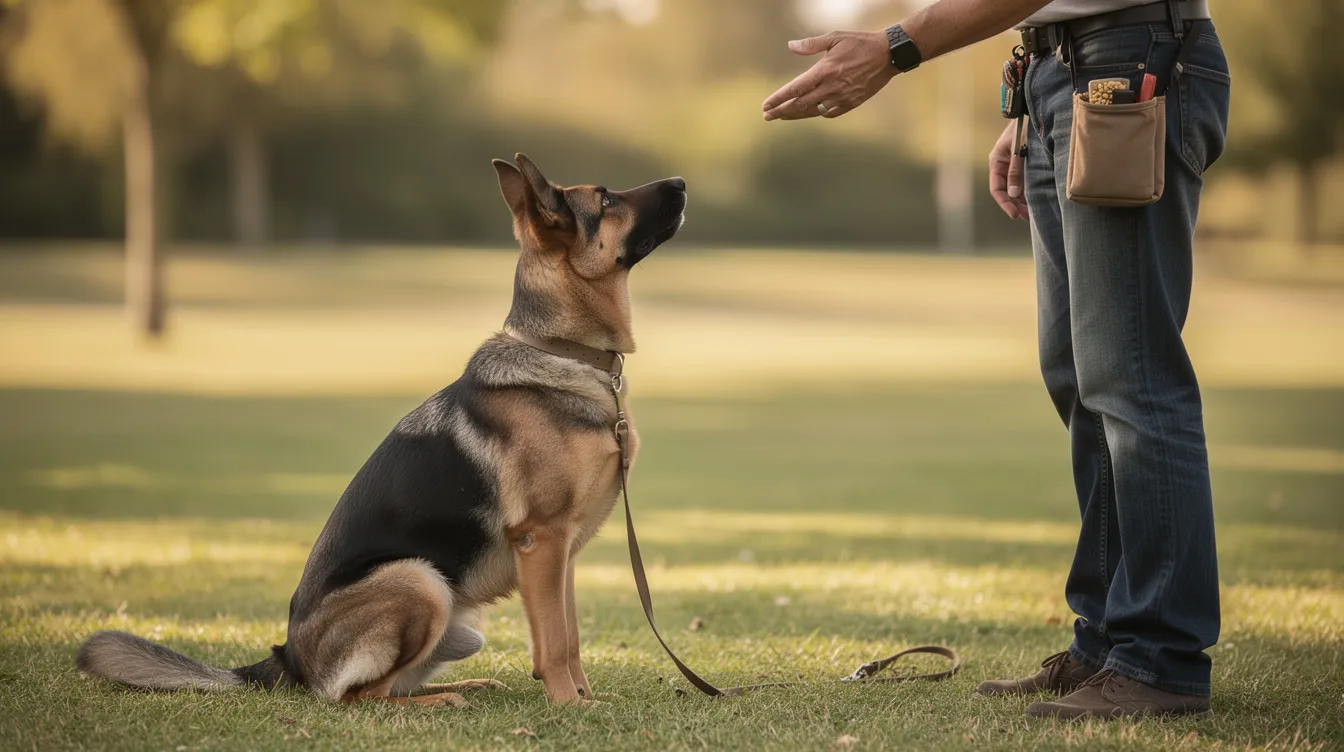
Training a German Shepherd starts at 8 weeks old and centers on consistent positive reinforcement, early socialization, and daily mental stimulation. German Shepherds rank among the top dog breeds in intelligence, which makes them exceptionally trainable-but also means they need structured guidance from the moment you bring your puppy home. This guide covers everything owners need to know about German Shepherd training, from foundation commands to solving breed-specific behavioral challenges.
This article addresses basic obedience, behavioral training, off-leash readiness, and advanced techniques tailored to the German Shepherd Dog. It does not cover breeding, health conditions, or specialized protection work beyond foundational concepts. Whether you’re a first-time German Shepherd owner in Northern Virginia or an experienced handler dealing with specific issues like leash reactivity or adolescent rebellion, this guide is built for you.
German Shepherds require consistent commands, rewarding desired behaviors from the earliest weeks, and a structured training process that evolves as the dog matures through critical development stages. Starting training early helps establish a bond of trust that lasts throughout the dog’s life.
By working through this guide, you will:
German Shepherds were originally bred for herding sheep in Germany in 1899, and that heritage shapes every aspect of how they learn. Unlike many other breeds, a purebred German Shepherd arrives with an intense working drive, protective instincts, and the intelligence to solve problems independently-traits that demand a specialized approach to training.
Working drive refers to an inherited motivation to perform tasks such as tracking, herding, and guarding. In the German Shepherd Dog, this drive is exceptionally high. These dogs are bred to have a job, and without one, they often channel their energy into unwanted behaviors like excessive barking, digging, or destructiveness.
Because German Shepherds are highly intelligent, a dog learns novel commands in as few as five repetitions and obeys known commands with remarkable accuracy. However, that same intelligence means your GSD will get bored quickly with repetitive drills. Providing mental jobs through training variety, puzzle toys, and nose work helps prevent boredom and keeps your German Shepherd engaged throughout the training process.
Protective instincts are hardwired into the German Shepherd’s temperament. While this makes them excellent watch dogs and loyal family companions, it can also manifest as overguarding or distrust of strangers-especially children or other dogs-if socialization is weak or inconsistent. Understanding this trait is crucial for owners who want a confident, well-adjusted dog rather than a reactive one.
The herding background also produces a tendency to control the environment. Many GSDs try to “manage” family members, other animals, and even household activity through nipping, stalking, and chasing. Rather than punishing these instincts, effective training channels them into acceptable outlets like fetch, agility, and structured obedience work.
The primary socialization window spans approximately 3 to 14 weeks of age. During this period, your German Shepherd puppy is most receptive to new stimuli-people, other dogs, surfaces, sounds, and environments. Introduce puppies to new experiences by 8 weeks old, and ensure German Shepherd puppies have regular positive experiences with strangers. Early socialization prevents fearfulness and aggression in dogs, setting the foundation for a stable adult temperament. Socialization helps German Shepherds become well-adjusted adults.
Secondary fear periods occur around 8–11 weeks and again during adolescence at roughly 6–14 months. During these windows, behaviors that seemed stable may regress, and your puppy may become more sensitive to stimuli that previously didn’t bother them. Socialization should be a continuous process that extends beyond puppyhood-research from 2025–2026 confirms that GSDs require ongoing novelty exposure throughout adolescence to prevent reversion of fears.
German Shepherds are classified as herding dogs, stand 22–26 inches tall at the shoulder, weigh 50–90 pounds depending on gender, and have an average lifespan of 10–12 years. They are known for their intelligence and loyalty, which is precisely why understanding these developmental stages matters before beginning practical training.

With a solid understanding of the German Shepherd’s breed characteristics, the next step is applying training methods that work with their natural tendencies rather than against them.
Marker training-using a clicker or a verbal marker like “Yes!”-is one of the most effective techniques for German Shepherds. Teaching a marker word helps dogs understand that a reward is coming after a desired behavior, creating precise communication between you and your dog. The timing must be immediate, within approximately one second, to ensure the dog connects the behavior to the reward. Positive reinforcement strengthens the bond between owner and dog, building trust and motivation simultaneously.
Using high-value rewards during training increases a dog’s motivation to learn. For most people, this means food rewards like small pieces of chicken, cheese, or liver treats-though some GSDs prefer play or toy rewards. German Shepherds tend to learn quickly when training is rewarding and engaging. Avoid overreliance on punishment, which tends to cause fear or defensive aggression in a breed already predisposed to protectiveness.
Training requires establishing clear communication for effective learning in dogs. Every family member must enforce the same commands and boundaries-who the dog sleeps with, whether jumping up is allowed, feeding rules, and greeting protocols. German Shepherds require consistent commands for effective training, and using clear commands prevents confusion during training sessions. If one person allows the dog on the couch while another doesn’t, you undermine the entire training process.
Leadership with a German Shepherd isn’t about dominance-it’s about being a predictable, fair figure that the dog trusts to make decisions. Established routines for feeding, training, and potty breaks are beneficial for dogs. This predictable structure prevents situational guarding behavior and helps your GSD understand what’s expected in every environment.
Physical and mental enrichment is important for a well-adjusted German Shepherd. Combining obedience training with problem-solving activities-puzzle feeders, scent work, tracking exercises, and learning novel tricks-builds frustration tolerance and impulse control. Impulse control exercises are recommended for German Shepherds to prevent unwanted behaviors.
German Shepherds require regular physical and mental activities, and a smart GSD without sufficient stimulation will create their own entertainment-usually in ways owners don’t appreciate. Asking your dog to sit before dinner, practice “leave it” during walks, or hold a “place” command during household chaos integrates training into daily life and keeps your German Shepherd’s active mind engaged.
With the right methods established, applying them systematically through each life stage ensures your German Shepherd develops reliable obedience that holds under real-world conditions.
Training should start as early as 8 weeks old. Begin with simple commands, and remember that training commands should be taught one at a time for effective learning. Training sessions should be short to maintain puppy attention spans-research shows attention spans at 8–12 weeks are limited to 30–60 seconds, increasing gradually with age. Here is the recommended protocol for teaching your dog the most important commands:
Expected timeline: basic versions of these commands by 12–16 weeks, more reliable responses by 6 months, and near-adult consistency at 12–24 months depending on the environment, distractions, and how consistent the training remains.
| Age Group | Session Length | Daily Frequency | Focus Areas |
|---|---|---|---|
| 8–16 weeks | 5–10 minutes | 3–4 short sessions/day | Socialization, crate & house training, name response, basic commands |
| 3–6 months | 5–15 minutes | 2–3 sessions/day | Continued obedience, loose leash work, impulse control, moderate distractions |
| 6–12 months | 10–20 minutes | 1–2 sessions/day | Adolescence challenges: stay, recall in real settings, boundary testing |
| 12+ months (Adult) | 10–20+ minutes | 1 session/day + reinforcement | Off-leash work, consistency under high distractions, behavior repair |
Puppy classes provide structured learning and socialization opportunities, especially during the 8–16 week window. As your German Shepherd matures, sessions can grow longer and more complex. Desensitizing German Shepherds to handling during early sessions also provides a stress-free grooming experience later in life. Adjust the schedule based on your dog’s energy level-a working-line GSD may need more frequent, challenging sessions than a show-line dog, and a female may mature slightly faster than a male.
| Approach | Timeline | Cost Range | Best For |
|---|---|---|---|
| DIY Home Training | Ongoing, lifelong | Low cost (treats, tools) | Owners with time, consistency, and foundational knowledge |
| Group Classes | 6–10 weeks typical | $150–$400+ (varies by region) | Puppies needing socialization, owners who prefer learning in distraction environments |
| Board-and-Train | 2–6 weeks intensive | $1,500–$4,000+ (depending on program) | Dogs with behavioral issues, busy owners wanting rapid transformation |
Professional trainers can provide tailored advice for behavioral issues that home training alone may not resolve. For owners in Northern Virginia’s busy suburban environment-with close neighbors, traffic, trails, and parks-a professional trainer who specializes in distraction-proof obedience and off-leash reliability can accelerate results significantly. The choice between DIY and professional training ultimately depends on your available time, your dog’s specific needs, and how quickly you need results. Many owners find the long-term benefits of board-and-train programs worth the investment, particularly for a breed as active and intelligent as the German Shepherd.

Even with the best foundation, German Shepherds present breed-specific challenges that most people encounter at some point during training. Addressing them early prevents escalation and keeps the training process on track.
German Shepherds are naturally watchful, but when protectiveness becomes excessive-barking at every visitor, guarding family members from friendly strangers, or lunging at other dogs-it requires deliberate intervention. The solution centers on controlled socialization: regular exposure to new people in calm settings, teaching a reliable “place” command to redirect the dog off perceived guard duties, and positive interactions with people to foster friendliness. Positive interactions with people foster friendliness in dogs over time. When protective behavior crosses into fear or aggression, a professional behavioral assessment is necessary-early intervention prevents entrenchment.
Leash reactivity is one of the most common challenges for German Shepherd owners, often caused by under-socialization, frustration at not being able to reach triggers, or sensitivity to the handler’s body language. Counter-conditioning-pairing the presence of a trigger with high-value treats at distances below the dog’s reaction threshold-is highly effective. Teach a “watch” or focus cue, use a front-clip harness, and reinforce every moment of calm behavior. Studies show that dogs trained gradually from larger distances improve significantly more than those repeatedly exposed at close proximity. This approach to reactive dog training requires patience and consistency, but produces lasting results.
Between 6 and 18 months, your German Shepherd undergoes hormonal, cognitive, and physical changes that can feel like your previously obedient puppy has forgotten everything. Selective hearing, pushing boundaries, and testing established rules are normal during this period. The solution is increasing structure rather than relaxing it: enforce the same commands consistently, reinforce earlier training daily, and avoid letting previously banned behaviors creep back. Keep sessions frequent but short, and stay patient-this phase is temporary, though it often lasts longer than owners expect. Full maturity in German Shepherds is often not reached until 18–24 months, particularly in males.
Adult German Shepherds-especially working-line GSDs-need at least 60–90 minutes of exercise daily, including activities like running, agility, and fetch. But physical exercise alone isn’t enough. Without adequate mental stimulation, behaviors like chewing furniture, digging, and panic during crate rest are common. The solution is a combination approach: structured physical activity, puzzle feeders and scent work for mental engagement, and proper crate training to create a safe, calm space. A tired body and a tired mind together produce a content, well-behaved German Shepherd.
Training a German Shepherd through these challenges requires understanding that each obstacle is rooted in breed-specific traits, not defiance. With the right approach, every challenge becomes an opportunity to build a stronger partnership.
Training a German Shepherd is a commitment that spans the dog’s entire life-from the first days you bring your puppy home through full adult maturity and beyond. The breed’s intelligence, working drive, and protective temperament demand consistent positive reinforcement, early and ongoing socialization, structured leadership, and daily mental stimulation. When these elements come together, the result is a confident, obedient companion capable of impressive off-leash reliability in any environment.
To begin or improve your German Shepherd training today:
For owners ready to go further, topics worth exploring include advanced off-leash training for trail and park reliability, therapy dog preparation for GSDs with stable temperaments, and foundational protection work concepts for dogs with strong working drives. Each of these paths builds on the obedience skills covered in this guide.
If you’re in Northern Virginia and want expert guidance specifically for your German Shepherd, Off Leash K9 Training offers free consultations to evaluate your dog’s needs and recommend the right program. For dogs requiring intensive behavioral modification, board-and-train programs provide focused, professional training with measurable results. Owners who have adopted or are considering a rescue German Shepherd can also explore German Shepherd rescues in Northern Virginia for breed-specific adoption resources.
Recommended training tools to support your work at home include front-clip harnesses for leash walking, a quality clicker or consistent verbal marker, puzzle feeders for mental enrichment, and high-value treats that your dog finds genuinely motivating. The right tools, combined with the skills and consistency outlined in this guide, set every German Shepherd owner up for lasting success.