
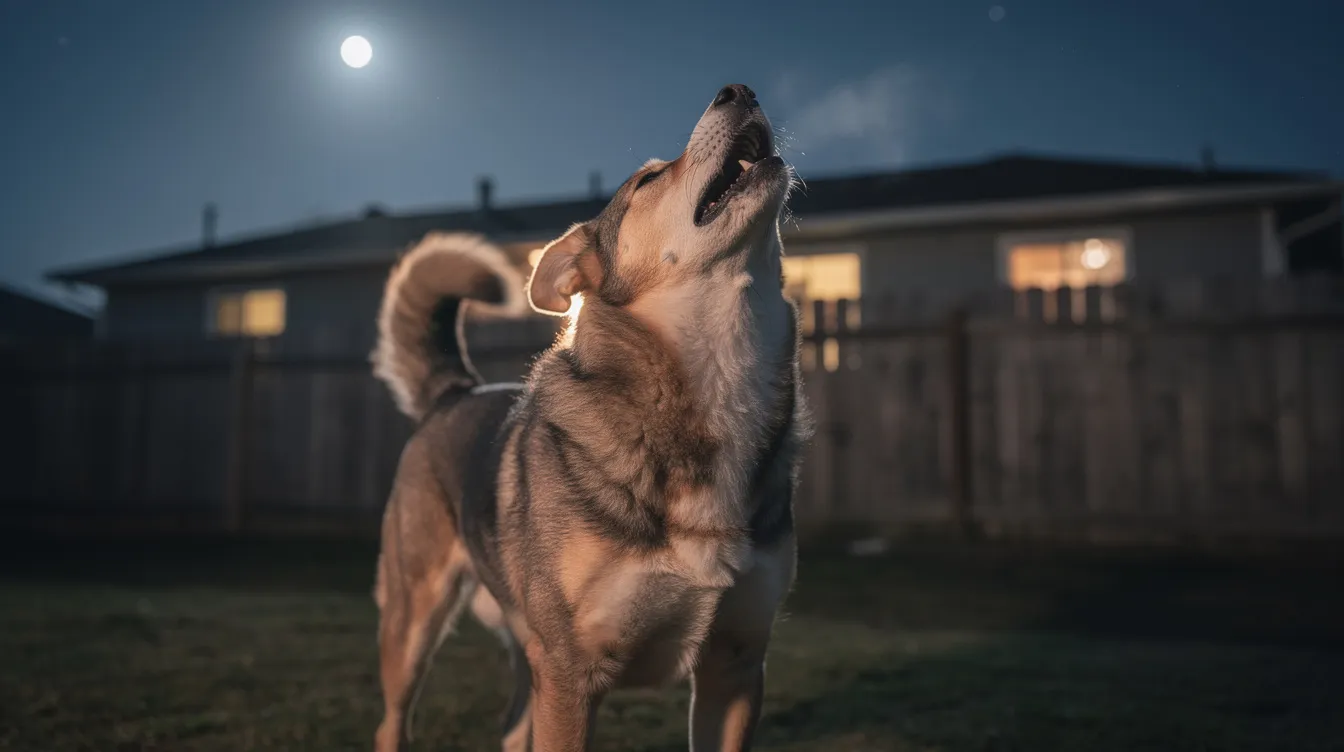
Dogs howl to communicate location, express emotions like anxiety or excitement, respond to high-pitched sounds such as sirens, and signal territorial boundaries. This behavior traces directly to their wolf ancestors, who relied on howling as their primary form of communication across long distances. Howling does not always indicate sadness in dogs; it serves multiple functions ranging from social bonding to alerting pack members of potential threats.
This article covers the biological origins of howling, the most common reasons dogs howl, breed-specific tendencies, and evidence-based training methods for managing excessive howling. It is written for dog owners in Northern Virginia who want to understand their dog’s vocalizations and learn when professional training intervention makes sense.
Dogs howl to communicate their location to others, express emotions and maintain social contact, respond to environmental sounds, and mark territorial boundaries. Separation anxiety may cause dogs to howl when left alone, while some breeds, like Huskies, howl more frequently than others due to genetic proximity to wolves.
By the end of this article, you will:
Howling is one of several vocal tools domestic dogs use, alongside barking, whining, and growling. Among these, howling functions as long distance communication, carrying further than other vocalizations due to its sustained tonal frequencies and harmonic structure. Understanding why and how dogs produce howls provides the foundation for addressing the behavior.
Wolves howl for long-distance communication and territory defense. Gray wolves use howls to contact separated pack members, coordinate group activity during hunts, and warn rival packs away from occupied territory. Wolf howling reduces direct physical confrontation between groups, serving as an acoustic fence line.
Domestication changed the balance between howling and barking. Dogs howl less frequently than wolves due to domestication, while barking increased as dogs adapted to living alongside humans. A 2023 study of 68 dogs across 28 pure breeds found that breeds genetically closer to wolves (termed “ancient breeds”) retained stronger howling responses. Modern breeds, by contrast, developed higher barking frequencies. The ancient roots of howling persist in every domestic dog’s vocal repertoire, but the degree varies based on genetic distance from wolves.
Dogs produce howls through their vocal folds, with the sound shaped by resonant chambers in the throat, mouth, and nasal cavity. A howl sustains tonal frequencies longer than a bark and includes multiple harmonics, which is why howls carry across long distances while barks dissipate more quickly.
Dogs’ hearing range extends from roughly 15,000 to over 60,000 Hz, giving them sensitivity to high pitched sounds that humans cannot detect. When a dog notices a siren, a musical instrument, or even household machinery producing frequencies within that range, the acoustic profile can mimic the structure of a howl. This explains why many dogs howl at sirens or respond vocally to sounds that seem unremarkable to their owners.
Understanding how dogs hear and produce sound explains why certain triggers provoke howling and others do not, which is essential for selecting the right training approach.

The reasons dogs howl fall into three broad categories: social communication, emotional expression, and environmental response. Each category requires a different management strategy, making accurate identification of the underlying cause the first step toward a solution.
Dogs howl to communicate their location to others. This behavior mirrors wolf pack dynamics, where a separated individual howls and the group responds. When your dog starts howling after hearing a neighbor’s dog, that is contagious howling: a vocal chain reaction where one howl triggers another. Neighborhood dogs in areas like Northern Virginia suburbs can set off cascading howl sequences in the same way wolves coordinate across territory.
Territorial instincts can trigger howling to warn off intruders. Territorial howling serves the same function as wolf howling directed at rival packs: it announces presence and claims space. Dogs may howl when unfamiliar people or other dogs approach their home, especially those breeds with strong guarding instincts.
Howling can indicate a dog’s emotional distress or loneliness. Separation anxiety is one of the most frequently cited causes of excessive howling, and it rarely occurs in isolation. Dogs experiencing separation anxiety typically also exhibit destructive chewing, pacing, excessive salivation, or house soiling when left alone for long periods. Howling in dogs can signal loneliness or separation anxiety, especially when the behavior occurs exclusively during the owner’s absence.
Dogs also howl to express excitement during play or anticipation of a walk. This type of vocalization is short-lived and accompanied by body language cues like tail wagging and bouncing. Fear-based howling, triggered by thunderstorms, fireworks, or environmental changes, looks different: the dog’s body language shows tucked tail, flattened ears, and avoidance behavior alongside the vocalization.
A 2025 case report of a Jack Russell Terrier with noise-related fear revealed that underlying musculoskeletal pain was amplifying the dog’s anxiety response. Treating the pain with appropriate analgesia, combined with environmental modifications, reduced the howling tied to noise triggers. This case illustrates why a veterinary exam should precede any behavioral intervention; howling can signal pain or discomfort in dogs that owners might misattribute to a purely behavioral issue.
Dogs may howl in response to high-pitched sounds like sirens, musical instruments, and emergency vehicles. This reaction appears to be instinctive rather than learned; the acoustic profile of a siren shares frequency characteristics with a howl, and the dog responds as though another canine is calling. When the sound stops, the howling typically ceases as well.
Attention seeking howling is a learned behavior. If a dog howls and receives any response from humans, including scolding, the dog learns that howling produces interaction. Even negative attention functions as reinforcement, which is why ignoring attention-seeking howling is a core training recommendation. Redirect your dog to a quieter activity when howling for attention, rather than engaging verbally.
Medical issues including pain, cognitive decline, and sensory loss also produce howling. Senior dogs experiencing cognitive dysfunction may vocalize at unusual hours, particularly at night. Older dogs of ancient breeds tend to howl more than younger ones, but a sudden change in howling patterns at any age warrants a vet visit. Consult a veterinarian for sudden, excessive howling, especially when accompanied by other symptoms like appetite loss, lethargy, or disorientation.
Breed predisposition plays a measurable role. Ancient breeds howl more frequently than newer breeds. Siberian Huskies howl more than Golden Retrievers, and hounds like Beagles are known for howling and baying. Breeds like Malamutes and Coonhounds are prone to howling as well. The 2023 breed study confirmed that certain breeds, like Huskies, howl more due to genetic traits connecting them to wolves, while older dogs of those ancient breeds showed longer solo howls and more stress behaviors during wolf howl playback experiments.
Identifying whether your dog’s howling stems from communication, emotion, or environment determines which training method will produce results.

At Off Leash K9 Training NOVA, addressing howling begins with structured assessment and proceeds through evidence-based behavior modification tailored to each dog’s triggers, breed, and severity.
Effective training requires data. Before starting any program:
Different triggers respond to different behavior modification protocols:
| Training Method | Best For | Timeline | Effectiveness |
|---|---|---|---|
| Quiet Command Training | Attention seeking howling | 2-4 weeks | High with consistency across all family members |
| Desensitization and Counterconditioning | Sound-triggered howling (sirens, neighborhood dogs) | 4-8 weeks | High when triggers are presented at low volume initially |
| Separation Anxiety Protocol | Isolation distress with destructive chewing and elimination | 2-6 months | High with combined behavior modification and veterinary support |
| Environmental Management | Contagious howling from outdoor sounds | Immediate | Moderate; best as supplement to training |
Teach a “quiet” cue to reduce howling. Start by waiting for a natural pause in howling, marking the silence with a reward word, and delivering a tasty treat. With repetition over 2-4 weeks, dogs learn that silence produces rewards while howling does not. Ignore howling to prevent attention-seeking behavior during this process.
Desensitization and counterconditioning (DSCC) works for sound-triggered howling. Play the triggering sound at low volume while rewarding calm behavior with positive reinforcement. Gradually increase volume across sessions. A review of separation anxiety treatments found that combining DSCC with medication yielded the strongest outcomes, while pure behavior modification was effective for dogs from shelters and rescues when implemented correctly.
For separation anxiety cases, a board-and-train program provides the intensive, controlled environment needed for behavior modification away from the triggers present in the home. In a study of 52 dogs with separation anxiety, 62% improved after behavior modification combined with owner compliance. When psychoactive medication such as amitriptyline was included, 56% of treated dogs improved. These interventions typically require 2-6 months for measurable improvement, and full resolution can take 6-12 months depending on severity.
Provide mental stimulation to decrease howling frequency. Puzzle toys, structured obedience training sessions, and quality time with the owner reduce boredom-driven vocalization. Dogs that receive adequate physical exercise and mental enrichment during the day produce fewer nighttime and absence-related howling episodes.
When one family member comforts a howling dog while another ignores it, the dog receives intermittent reinforcement, which makes the behavior more persistent rather than less. Every person in the household must follow the same protocol: ignore attention-seeking howling and reward quiet behavior. Even scolding counts as attention. Establish written household rules and review them weekly until the new response pattern becomes automatic for everyone.
In Northern Virginia’s suburban neighborhoods, one howling dog can trigger a chain of contagious howling across multiple yards. White noise machines, soft music, and window coverings reduce auditory stimulation from other dogs. Combine these environmental tools with counter-conditioning training during the hours when neighborhood dogs are most vocal. Over 4-8 weeks of consistent practice, dogs learn to respond to neighborhood triggers with an alternate behavior rather than joining the chorus.
Some dog breeds are genetically wired to vocalize. Siberian Huskies, Alaskan Malamutes, Beagles, and Coonhounds have vocal tendencies that owners should expect rather than try to eliminate. The 2023 breed study confirmed that ancient breeds retain stronger howling responses than modern breeds, and this gap widens with age. The realistic goal is teaching reliable quiet cues and alternate behaviors rather than attempting full suppression, which can create frustration and stress for both dog and owner.
When an older dog that has never been vocal suddenly begins howling at night, cognitive dysfunction is a common explanation. A veterinary behaviorist can evaluate whether medication for cognitive decline is appropriate. Environmental modifications such as night lights (to reduce disorientation), consistent daily routines, and gentle behavior modification techniques support senior dogs through this transition. Pain-related howling in older dogs also requires veterinary assessment; as the Jack Russell Terrier case demonstrated, treating underlying musculoskeletal pain can resolve vocalization that appeared to be purely behavioral.
Professional guidance makes the difference between months of trial-and-error and a structured path to improvement.
Howling is a natural part of canine communication, not a behavioral flaw. Dogs inherited this form of communication from wolves, and it persists across all breeds to varying degrees. Punishment increases anxiety and worsens howling; understanding the trigger and responding appropriately with structured training produces lasting results.
Start with these concrete steps:
Related resources for Northern Virginia dog owners include general obedience training, separation anxiety management protocols, and reactive behavior modification programs available through Off Leash K9 Training NOVA.
Is howling normal behavior or a sign of distress? Howling is a natural behavior inherited from wolves and serves as a form of communication for all domestic dogs. It becomes a concern when accompanied by other signs of distress such as destructive chewing, pacing, elimination in the home, or when a previously quiet dog suddenly begins howling. Evaluate the context and your dog’s body language to determine whether the howling reflects normal communication or an underlying problem.
Which dog breeds howl the most and why? Ancient breeds howl more frequently than newer breeds due to closer genetic ties to wolves. Siberian Huskies, Alaskan Malamutes, Basenjis, Shar-Peis, Shiba Inus, and Chow-Chows rank among the highest-howling breeds. Hounds like Beagles are known for howling and baying as part of their bred-in tracking behavior. Breeds like Malamutes and Coonhounds are prone to howling for the same reason.
How long does it typically take to reduce excessive howling through training? For sound-triggered or attention seeking howling, consistent training produces measurable changes within 2-8 weeks. Separation anxiety cases require 2-6 months for improvement, with full resolution potentially taking 6-12 months depending on severity and owner compliance with the training protocol.
Can e-collar training help with howling behavior modification? E-collar training should only be used under the guidance of a qualified trainer and as part of a broader positive reinforcement program. For anxiety-related howling, e-collar use without proper professional oversight can worsen the anxiety driving the behavior. Off Leash K9 Training NOVA integrates e-collar work into structured programs where the tool is used sparingly and humanely alongside other techniques.
When should I seek professional dog training help for howling issues? Seek professional help when howling persists despite consistent home training for 4 or more weeks, when separation anxiety symptoms accompany the howling, when your dog is howling due to fear or reactivity, or when a veterinarian has ruled out medical issues and recommended behavioral intervention.
Will my dog’s howling get worse if I ignore it completely? Temporarily, yes. When you stop reinforcing attention-seeking howling, dogs often increase the behavior before giving up. This is called an “extinction burst.” Consistency through this period is critical; giving in during the burst teaches the dog that louder, longer howling works. With consistent ignoring and rewarding of quiet behavior, the howling decreases within 2-4 weeks.
How does Off Leash K9 Training NOVA address howling in board-and-train programs? The board-and-train program begins with a full behavioral assessment to identify howling triggers, breed tendencies, and severity. Trainers implement desensitization protocols for sound-triggered howling, structured quiet cue training, and separation anxiety modification in a controlled environment. Owners receive transition training to maintain consistency at home after the program. Progress is tracked through episode counts, duration measurements, and video documentation.