
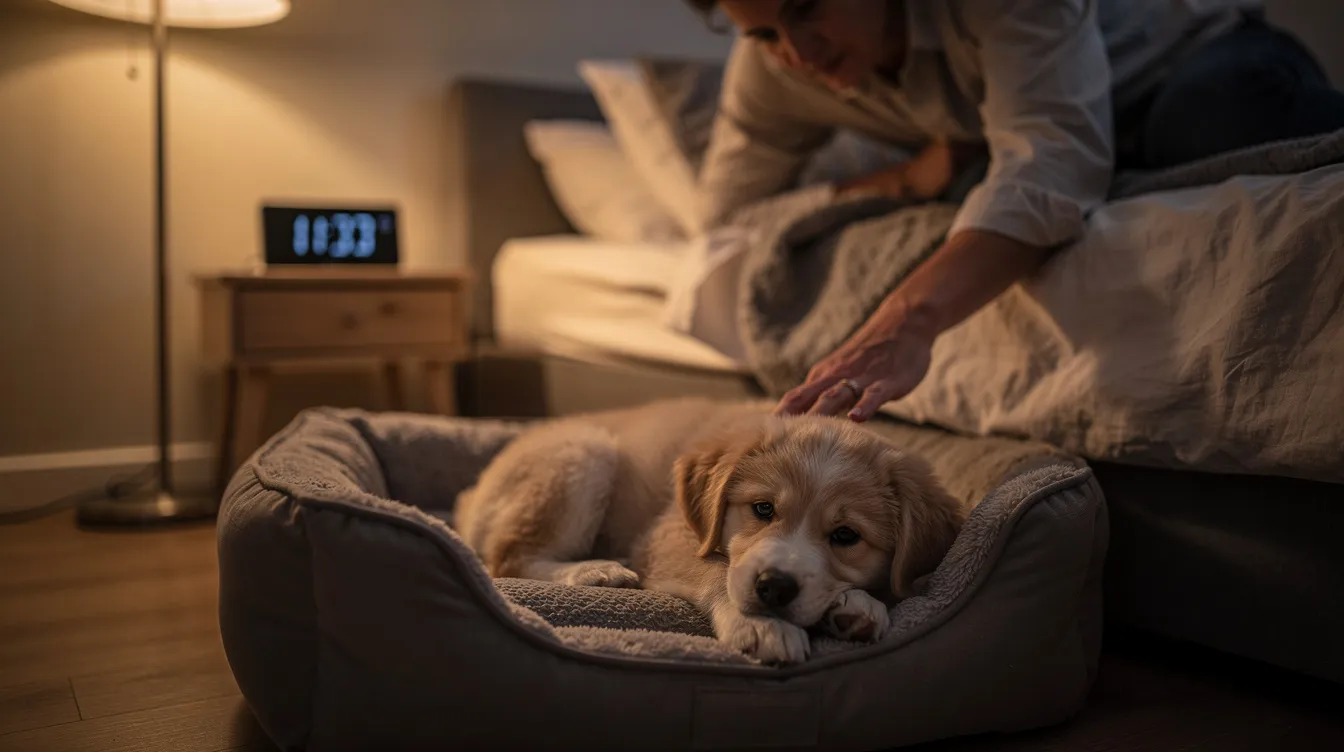
Puppy sleep regression is a temporary phase of disrupted sleep patterns where a previously good sleeper starts waking multiple times per night, whining in the crate, or refusing to settle at bedtime. If your pup was sleeping through the night and has suddenly started waking at 2 a.m. with no obvious cause, you are likely dealing with regression rather than a training failure.
This article covers the developmental and environmental causes behind puppy sleep regression, from teething and fear periods to routine changes and seasonal noise. It does not cover puppies who never established good sleep habits in the first place, nor does it address medical issues requiring veterinary care. The target audience is pet parents in Northern Virginia with puppies between 3 and 18 months old who want concrete, actionable protocols to restore restful sleep.
Puppy sleep regression occurs most often during two developmental windows: the 4-to-6-month puppy stage, when a puppy’s sleep architecture changes and teething peaks, and the 6-to-14-month window, when fear periods and adolescent hormonal shifts overlap. Environmental disruptions like household changes or seasonal noise can trigger regression at any age in dogs.
By the end of this article, you will be able to:
Sleep regression describes a temporary return to disrupted sleep in puppies who had previously been sleeping through the night. Common signs of puppy sleep regression include night waking, bedtime resistance, and nap refusal. The disruption is not random; it tracks with specific developmental milestones or environmental shifts and resolves with consistent care, typically within a few weeks.
Why does your dog’s sleep matter beyond your own sleepless nights? A review published in AAHA’s Trends Magazine found that dogs with low disturbance thresholds (those who wake easily) scored higher on behavior problem scales. Sleep consolidates learning, supports immune function, and shapes temperament. A puppy struggling with sleep regression often struggles with crate training, recall, and impulse control during the day as well.
Puppies need about 18 to 20 hours of sleep daily in their earliest weeks, though that number drops as they mature. A longitudinal survey of 2,332 puppies published in the Journal of Veterinary Behavior found that at 16 weeks, total 24-hour sleep averaged about 11.2 hours (roughly 7.0 hours at night, 3.5 hours during the day). By 12 months, nighttime sleep increased slightly to about 7.3 hours while daytime sleep dropped to roughly 3.0 hours.
Most puppies sleep through the night by three to four months. “Sleeping through the night” for a puppy means 6 to 8 uninterrupted hours, or with one potty break for younger pups. A puppy’s bladder can hold it for hours equal to their age in months; a two-month-old puppy can hold its bladder for two hours, a four-month-old for four.
Sleep regression looks different from a puppy that never learned to settle. If your puppy was reliably sleeping 6+ hours and has now started waking multiple times, that is regression. If your new puppy has never managed more than 3 hours of continuous sleep, that is a habit-building problem, not a regression. The distinction matters because the solutions differ.
Developmental triggers are biological changes your puppy’s body and brain impose on sleep patterns. Between 3 and 5 months, a puppy’s sleep architecture changes: REM phases increase, lighter sleep stages become more common, and the prefrontal cortex is still maturing. Teething, growth spurts, and fear periods compound these neurological shifts. None of these can be eliminated; they can only be managed.
Environmental triggers are external disruptions to your dog’s routine: a change in bedtime, a new baby in the house, construction noise, or seasonal shifts. Routine changes can disrupt a dog’s sleep schedule, and new household members can trigger sleep regression in dogs. These triggers are controllable, which makes them the logical starting point for intervention.
Most cases of sleep regression involve both categories at once. A puppy at 5 months may be dealing with teething pain and a schedule shift from a family vacation. Identifying which factors are at play determines which protocol to follow.

Developmental sleep regression follows a rough timeline. Understanding where your puppy falls on that timeline narrows down the likely cause and the appropriate response.
A puppy’s sleep cycle shift at 4 months is the single most common trigger for first-time sleep regression. Between 3 and 5 months, the puppy brain transitions from neonatal sleep patterns (deep, consolidated sleep with fewer transitions) to adult-like sleep cycles with more frequent transitions between light and deep sleep stages. The result: a puppy who could fall asleep easily and stay down for 7 hours now wakes during lighter phases and cannot self-soothe back to sleep.
Teething compounds this. According to PetMD’s teething timeline, baby teeth start falling out around 3.5 to 5 months, premolars erupt between 4 and 6 months, and molars come in around 5 to 7 months. Teething pain can disrupt a puppy’s sleep patterns, causing the pup to chew on crate bedding, whine, or pace instead of settling. Frozen chew toys and cooling treats before bed reduce discomfort enough for many puppies to sleep.
Growth spurts add a third layer. Large-breed puppies gaining several pounds per month may experience joint and muscle discomfort at night. The AKC notes that panosteitis, an inflammation of long bones, appears most often between 5 and 18 months in large breeds, causing limb pain that disrupts sleep.
With consistent management, this regression window typically resolves in 1 to 2 weeks. The key is not to abandon crate time or the bedtime routine during this period.
Fear periods occur between 8-12 weeks and 6-14 months. The first fear period overlaps with the earliest puppy stage and rarely causes sleep regression because most puppies have not yet established a stable sleep baseline. The second fear period is the one that catches owners off guard.
Between 6 and 14 months, the puppy’s amygdala ramps up threat-detection activity. According to BreedTools’ developmental research, each fear period episode typically lasts 2 to 3 weeks and can occur in waves. During this window, a puppy that previously settled in a dark room may suddenly refuse to enter the crate, startle at normal household sounds, or wake in a panic. Dogs are crepuscular and most active at dawn and dusk, which means fear-period puppies often become restless during twilight hours when their arousal is already elevated.
The mechanism is straightforward: heightened amygdala activity lowers the threshold for waking. A noise that the puppy slept through last week, a car door, a furnace kicking on, now triggers a full arousal response. In Northern Virginia’s suburban environment, where street noise, leaf blowers, and seasonal thunderstorms are constant, these triggers multiply.
A crate cover that blocks visual stimuli and white noise to mask intermittent sounds are the two most effective immediate interventions for fear-period sleep disruption.
Adolescence in dogs stretches from roughly 6 to 18 months, with the most acute hormonal shifts concentrated between 6 and 10 months. Intact puppies experience surges in reproductive hormones during this window. Even spayed or neutered puppies can show residual hormonal effects because the hypothalamic-pituitary axis takes time to recalibrate after surgery.
The behavioral result is a puppy that resists the established nighttime routine. Where a 4-month-old might whine briefly and settle, a 9-month-old in adolescence may bark, dig at the crate door, or refuse to lie down for 30+ minutes. This is not the same emotional response as fear-period anxiety; it is closer to boundary-testing. The puppy is awake, alert, and pushing for more freedom.
For large breeds, this phase extends toward 18 months. Sleep regression episodes may recur two or three times across the full adolescent window, each lasting 1 to 3 weeks. Consistency during these periods determines whether the behavior extinguishes or becomes entrenched.

Developmental triggers set the stage, but environmental triggers often determine whether a regression actually occurs. A 5-month-old puppy going through teething may sleep fine in a stable environment but regress immediately after a schedule change or move to a new environment.
When a puppy who was sleeping through the night has started waking again, and you have ruled out a medical issue (pain, illness, digestive upset), this four-step protocol addresses both environmental and behavioral factors.
For owners who want hands-on guidance with this protocol, our puppy training programs include sleep regression support as part of the overall training structure.
| Trigger Category | Common Examples | Typical Timeline | Management Approach |
|---|---|---|---|
| Routine changes | New feeding schedule, shifted bedtime, travel | Onset within 1-3 days of change | Restore previous routine or establish new consistent one |
| Household additions | New baby, new pet, houseguests | Onset within first week | Gradual introduction, maintain puppy’s crate and sleep space |
| Seasonal/noise | Thunderstorms, fireworks, construction, leaf blowers | Correlates with season or local activity | White noise machine, crate cover, interior room placement |
| Temperature | Hot summer nights, cold winter drafts | Correlates with weather shifts | Cooling pad, fan, insulated crate, adjust room temperature |
| Social disruption | Owner schedule change, separation anxiety triggers | Variable | Increase mental exercise and physical exercise earlier in the day; structured crate time |
To identify your puppy’s most likely trigger, map the regression onset against your puppy’s age (developmental window) and any recent environmental changes. If your 5-month-old started waking after you moved the crate to a different room, you have an environmental trigger layered on a developmental one. Address the environmental factor first; it is the one you control.
Implementing scheduled daytime naps can help prevent overtiredness in puppies. An overtired puppy may exhibit hyperactivity rather than sleepiness, which makes bedtime harder. For most dogs, structured nap times in the crate during the day reinforce the crate-as-rest-space association and reduce nighttime resistance. Our guide to crate training covers daytime and nighttime crate protocols in detail.
Even with a clear protocol, dealing with puppy sleep regression involves specific friction points. These are the three scenarios Northern Virginia puppy owners ask us about most often.
Not all crying is the same. Distress crying, which signals pain, illness, or an urgent potty need, is higher-pitched, escalating, and does not pause when the puppy hears you move. Attention-seeking crying is rhythmic, repetitive, and often stops briefly when the puppy hears footsteps or a door opening.
When to check: if the puppy sounds panicked, if you suspect the pup needs to pee (calculate bladder capacity by age in months), if the crate is too hot or cold, or if you hear sounds of physical discomfort. Otherwise, wait. Calm bedtime routines help puppies settle down for sleep, but responding to every sound trains the puppy that crying produces results. If you need to check, do so quietly, without eye contact or verbal interaction, confirm the puppy is safe, and leave. Calming treats given before bed (not in response to crying) can take the edge off for teething or anxious puppies.
This happens when intermittent reinforcement creeps back in. If the puppy wakes on night 12, and someone lets the dog out of the kennel because “it worked for 10 days, something must be wrong,” the puppy learns that persistent crying on later nights pays off. The behavior returns stronger than before.
The fix: restart the protocol from step one. Check for any new environmental change that preceded the setback. Re-commit to the full 7-to-14-day window. Track night wakings in a log (date, time, duration, your response) so you can identify patterns rather than reacting to individual bad nights. Some regression during adolescence is normal; the goal is not zero disruptions but rapid self-settling.
One person following the protocol while another sneaks the puppy into bed creates confusion. The puppy does not generalize “bedtime means crate” if bedtime sometimes means the couch in the living room.
Write a single plan. Post it where everyone can see it. Assign specific roles: who feeds dinner, who handles the final potty break, who responds (or does not respond) to nighttime fussing. If children are involved, make the rule simple and absolute: “We do not open the crate at night. If you hear the puppy, come get an adult.” Consistency across all household members is the single highest-leverage change you can make. For families struggling with this, our board and train programs remove the variable entirely by establishing the routine in a controlled environment before the puppy returns home.
Puppy sleep regression is a normal part of development, not a sign that your training has failed. Most cases resolve within 2 to 3 weeks when you correctly identify the trigger (developmental or environmental) and apply a consistent response protocol without exceptions.
Your immediate action steps:
If your puppy’s regression persists beyond 3 weeks despite consistent protocol, or if you notice signs of pain, illness, appetite loss, or extreme anxiety (refusal to eat, aggression, hiding), a veterinary assessment is necessary for persistent changes in sleeping patterns accompanied by illness signs. Separation anxiety that extends beyond nighttime may also require professional behavior modification rather than sleep-specific protocols.