
Attention: Dogs bark excessively from excitement, fear, alerting Dog barking training is not about stopping every sound your dog makes. A brief alert when someone is at the door can be normal. The goal is to reduce excessive barking that takes over the home, disrupts guests, or makes walks stressful.
If your barking dog reacts to visitors, loud noises, squirrels outside the window, or other dogs on walks, the answer is usually more structure, not more yelling. This guide explains why dogs bark excessively and how to teach quiet behavior with calm routines, dog obedience, and consistent practice.
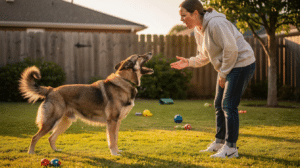
Dogs bark at guests, sounds, people, animals, and other dogs for many reasons. Barking is communication, but it can become an unwanted behavior when the dog cannot settle, recover, or remain quiet after the trigger appears.
Different types of barking include alert barking, alarm barking, territorial barking, attention-seeking barking, frustration barking, boredom barking, and anxiety-related barking. Dogs may bark because they are excited, scared, frustrated, protective, under-stimulated, or trying to get a response. The right training plan depends on why the dog is barking, not just how loud or frequent the barking sounds.
Here are common reasons a dog starts barking around guests and distractions:
Barking can also be reinforced by accident. If a guest backs away, the dog may think barking worked. If family members rush over, scold, or give treats at the wrong time, the dog may learn that barking creates action. Dogs should not be rewarded for barking to get attention.
Understanding the root cause of a dog’s excessive barking helps you choose the right training plan. A pup barking from boredom needs more exercise and enrichment. A puppy barking because it is scared of strangers needs slower exposure and confidence-building. A dog with separation anxiety may need a more detailed behavior plan than a simple quiet cue.
Dog barking training and dog obedience training should teach dogs exactly what to do when guests arrive or distractions appear. Instead of only saying “quiet” after the dog barks, give the dog a predictable job before the situation gets out of control.
For example, the rule might be: when the doorbell rings, the dog goes to the place command, lies down, and waits until released. Or when dogs pass during walks, the dog heels beside the owner and gives eye contact instead of lunging and barking.
Clear house rules help reduce barking because they remove confusion. Decide who handles the door, where the dog goes, when the dog may greet, and what happens if the dog barks. Written guidelines help family members stay consistent.
Yelling, repeating commands, or reacting emotionally often makes barking worse because it can add more excitement or stress. Punishing dogs for barking may also increase fear or anxiety in some cases. An anti-bark collar may suppress sound for some dogs, but it does not teach an alternative behavior or address why the dog is barking.
Prevent repeated practice of the barking habit whenever possible. Use a leash, crate, baby gate, or closed room when needed so the dog cannot rush into the hot zone at the front door and rehearse the same reaction every day.
Start in the first place your dog can succeed: a calm home environment. Do not begin with a crowd of guests, a real delivery, and a loud doorbell. Train the behavior before testing it.
Use this simple process:
Teach a “quiet” command to reinforce silence. To do this, allow one brief alert, say “quiet” once in a calm voice, then reward the moment the barking stops. The goal is not to reward barking. The goal is to teach the dog that quiet behavior, calm focus, and settling after the cue are what earn the reward.
Redirect barking by asking for an incompatible behavior. Teach dogs to perform incompatible behaviors to stop barking, such as sit, down, place, heel, or eye contact. A dog cannot calmly hold a down-stay on a bed and rush the door at the same time.
Rewarding calm behavior when a dog spots a trigger can change their emotional response. Effective training methods include desensitization and counter-conditioning. Desensitize dogs to triggers by gradually exposing them to sounds, movement, guests, and other dogs at a level they can handle.
Short training sessions are often more effective than one long session. Practice for brief periods several times a day, then stop before the dog becomes frustrated or overstimulated. Keep the dog busy with puzzle toys, safe toys, crate games, and structured rest so the dog practices calm behavior throughout the day.
Environment matters too. Barking can be reduced by changing the dog’s environment. Blocking windows can help prevent barking at passersby. Using white noise machines can reduce outdoor noise triggers for barking. White noise can be especially useful in apartments, townhomes, or homes near sidewalks where dogs pass often.
Exercise needs vary by age, breed, health, and energy level. Increasing daily physical activity can help reduce barking from boredom, but exercise alone is not the full solution. Many dogs also need mental stimulation through training games, sniffing, food puzzles, structured walks, and calm rest.

Solid obedience gives you tools before the dog loses focus. Most dogs do better when they know exactly what earns the reward and what does not.
Use these skills to reduce barking:
| Skill | How it helps |
| Sit | Gives the dog a still position instead of jumping or rushing forward. |
| Down | Helps lower arousal and encourages calm body language. |
| Place | Sends the dog to a defined bed or mat when guests arrive. |
| Stay | Builds the dog’s ability to hold position while the door opens. |
| Heel | Helps the dog walk past distractions, dogs walking nearby, and other dogs. |
| Recall | Lets you call the dog away from a window, fence, door, or squirrels. |
Train each skill in low-distraction areas first. Then add mild noise, movement, and distance. Identifying the distance at which a dog begins to bark is important for training. If the dog barks at other dogs from 20 feet away, start at 40 or 50 feet where the dog can still think.
As a practical example, if dogs pass outside the window and your dog starts barking, move the dog farther from the window, ask for sit or place, and reward quiet focus. If your dog cannot respond, the setup is too hard. Increase distance, lower the sound, or block the view.
A study published in Applied Animal Behavior Science evaluated a positive-reinforcement training protocol using a platform down-stay and a remote food reward dispenser for dogs that barked, jumped, or crowded the door when people arrived. This supports the idea that teaching a clear place or down-stay behavior can help dogs respond more calmly at the door. Some trainers also use a remote feeder to reward quiet behavior at a distance, but timing and structure still matter.
Ignoring barking can help reduce attention-seeking behavior. It is sometimes helpful to ignore demand barking, but only if you also reward quiet approaches, calm eye contact, or a polite sit. Ignoring is not enough if the dog is scared, panicking, or reacting from anxiety.
For long periods of barking, barking paired with growling, or barking connected to separation anxiety, fear, or aggression, get help. Barking has different causes, so addressing the cause is more effective than only trying to suppress the sound.
Dog barking training works best when it provides your dog with a clear alternative to barking. Instead of simply trying to stop the noise, the goal is to teach your dog to go to their place, remain quiet, focus on you, wait patiently, and greet calmly when released.
Teaching quiet behavior requires consistent practice. Excessive barking can be managed by rewarding calm responses, building impulse control, and gradually practicing around distractions. Success is easier when your dog receives sufficient exercise, mental stimulation, short training sessions, and clear expectations from everyone in the household.
If managing your dog’s barking feels overwhelming or unsafe, consider seeking professional dog training. You can review available training program options or contact a qualified professional trainer to discuss barking, obedience, impulse control, calm greetings, recall, and better behavior around guests and distractions.

Some dogs begin improving within a few weeks of consistent daily practice, especially when barking is mild and the dog already understands place, sit, stay, and quiet; fear-based, anxiety-related, or long-term barking may take longer and may need professional support.
Measure progress by shorter barking bursts, faster recovery, and calmer greetings. The goal is not instant silence. The goal is better control, more calm choices, and a dog that can recover after a trigger.
Start by changing the setup. Use white noise, close curtains, move furniture away from the window, and reduce access to areas where the dog can rehearse barking.
Then pair low-level building sounds with treats. When the dog hears a soft noise and stays calm, reward. Over time, the dog learns that normal apartment sounds are not emergencies.
Yes. Let the dog give one brief alert, then cue “quiet,” “place,” or “sit.” Reward silence and calm focus after the first bark.
Be consistent. Do not open the door, allow greetings, or give attention while the dog is still barking. The dog learns that calm behavior makes good things happen.
Yes, but mainly for attention-seeking barking. If the dog barks to get food, play, or attention, ignoring can help, as long as you reward quiet behavior instead.
Do not ignore barking caused by fear, panic, or a real trigger. A scared dog needs guidance, distance, and gradual training, not abandonment.
Seek help if barking includes lunging, growling, snapping, or intense reactions toward guests, strangers, or other dogs. Also get support if the barking continues for long periods, causes neighbor complaints, or makes daily life difficult.
A qualified trainer can help you train safer routines, teach calmer greetings, and build obedience skills that make quiet behavior more reliable around real-world distractions.